Why trusted infrastructure data has become a prerequisite for deployment speed, operational efficiency, and AI adoption
“Source of truth” has become one of the most common phrases in telecom infrastructure, appearing in conversations about asset management, deployment workflows, engineering, operations, and increasingly, AI. Yet despite how frequently the phrase is used, organizations often define it differently.
For some, a source of truth is an asset management platform, while for others, it is a CRM, document repository, or database. These systems help centralize information and make it accessible, but simply storing information in one place does not guarantee that it is accurate, current, or reliable.
The Connect(X) 2026 Spotlight Session highlighted an important distinction for the telecom industry: a source of truth is where information lives, while a verified source of truth is information that has been validated and can be trusted.
Telecom Infrastructure Data Is Inherently Complex
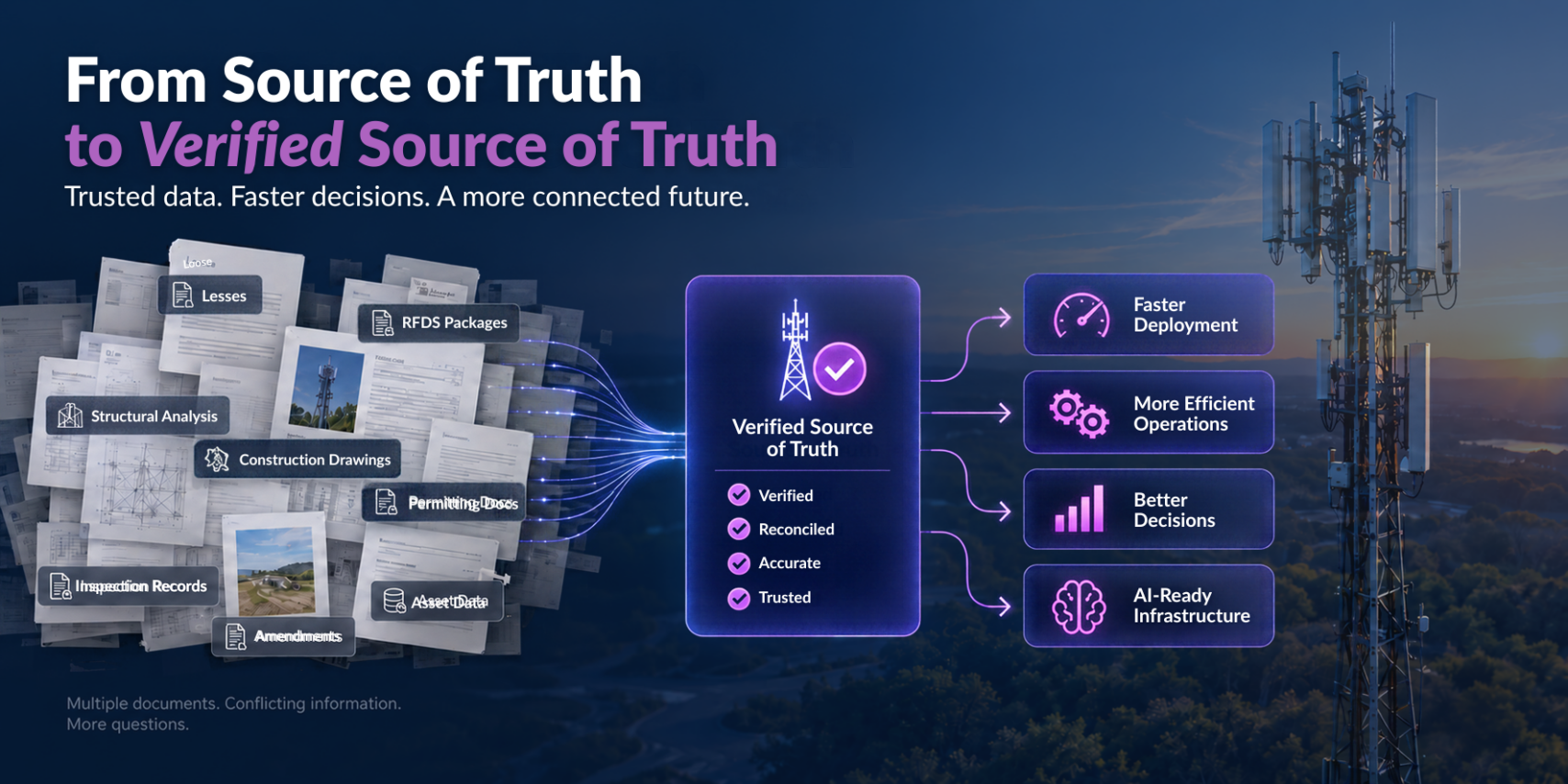 Telecom assets generate enormous amounts of information throughout their lifecycle, with a single site potentially containing lease agreements, amendments, RFDS packages, structural analysis reports, construction drawings, permitting documentation, inspection records, and asset management data.
Many of these documents were created years apart by different organizations using different processes and systems, making it difficult to maintain consistent information as sites change over time.
Information may be duplicated, records may become outdated, and different documents may contain conflicting details about the same asset. As a result, teams often spend significant time determining which information is correct before they can begin engineering, permitting, or construction work.
Why Systems of Record Are No Longer Enough
Telecom organizations have historically invested in systems of record to centralize information, improve accessibility, and give teams a common place to manage infrastructure data.
While centralization is an important step, it does not resolve inconsistencies between documents or establish which information should be trusted when records conflict.
As D.J. Grosso of Harmoni Towers explained during the Connect(X) Spotlight Session:
“Any AI system is not going to fix your data. If your data is trash, any AI system that you put on top of that is going to be compounded into absolute chaos.”
The same principle applies beyond AI, because a centralized system containing inaccurate or outdated information simply makes that information easier to access and potentially easier to distribute across an organization.
Trust cannot be assumed simply because information exists in a system; it must be established through validation.
What Makes Information “Verified”?
A verified source of truth is built through validation, which requires organizations to compare information across multiple sources, identify discrepancies, and reconcile conflicting records before that information is used in downstream workflows.
For a telecom site, this means answering questions such as:
- Does the lease agreement align with the RFDS package?
- Does the structural analysis reflect current site conditions?
- Do construction drawings match approved designs?
- Are amendments reflected throughout the workflow?
These checks help teams identify inconsistencies before they affect engineering, permitting, construction, or other activities that depend on accurate site information.
When discrepancies are identified early and resolved, teams can spend less time questioning the information they receive and more time completing the work that depends on it.
The value of a verified source of truth is not simply having more accurate records, but giving teams greater confidence in the information they use to make decisions.
The Operational Impact of Trusted Information
The benefits of a verified source of truth extend beyond documentation because accurate, validated information supports nearly every stage of the telecom deployment lifecycle.
With trusted information, organizations can improve forecasting accuracy, accelerate project reviews, reduce repetitive manual validation, minimize revision cycles, strengthen workflow coordination, and make decisions with greater confidence.
During the Connect(X) discussion, Nat Mangum emphasized the importance of establishing accurate information at the beginning of a process:
“Getting that first step correct, that validation step correct, allows all the other steps to be successful.”
Validation at the beginning of a workflow gives downstream teams a more reliable foundation for their work, reducing the risk that an outdated drawing, incorrect asset record, or conflicting document will create additional revisions later in the process.
Rather than repeatedly verifying the same information at every stage, teams can work from validated records while continuing to review new information and changes as they emerge.
Why Trusted Data Matters for AI
The rise of AI has made the need for a verified source of truth more urgent, as organizations increasingly use AI to process infrastructure documents, analyze site information, and execute complex engineering and operational workflows.
AI systems depend on the quality of the information they receive, and incomplete, outdated, or conflicting data can produce unreliable outputs that affect subsequent stages of an automated process.
For telecom organizations, successful AI adoption requires more than connecting an AI system to an existing document repository or asset management platform. It requires processes that validate information, identify conflicts, and involve human reviewers when discrepancies cannot be resolved automatically.
Establishing trusted information allows organizations to automate more of their workflows without simply accelerating the errors and inconsistencies that already exist in their data.
Validation is no longer just a data management exercise; it is a foundational capability for deploying AI reliably across telecom infrastructure operations.
Looking Ahead
The telecom industry has spent decades building systems to store, organize, and manage infrastructure information, but the next phase requires organizations to establish whether that information can actually be trusted.
A verified source of truth goes beyond a platform, database, or document repository by providing validated information that teams can confidently use to make decisions, execute projects, and manage infrastructure.
As deployment programs become more complex and organizations continue adopting AI and automation, maintaining accurate information across documents, systems, and workflows will become increasingly important.
Before teams can accelerate deployment, automate engineering processes, or improve operational performance, they need confidence in the information guiding those activities.
That confidence starts with validation, which transforms stored information into a verified source of truth.
At a Glance
The phrase “source of truth” is used throughout the telecom industry, but not all sources of truth are created equal. A verified source of truth is more than a repository of documents or an asset management system—it is trusted information that has been validated and can be used to confidently make decisions.
This article explores why data validation is becoming foundational to telecom operations and how organizations are creating trusted information across leases, RFDS packages, structural analysis, and construction documentation.
Key Takeaways
- A source of truth is not simply where information is stored
- Trusted data must be validated across multiple sources
- Poor data quality creates downstream delays and rework
- Validation improves forecasting, decision-making, and execution
- Trusted information is essential for automation and AI
Powerful Automation, Endless Possibilities.
Become an early adopter today and enjoy VIP benefits and opportunities to contribute to our advisory community!